About FLIR E76 Thermal Imager
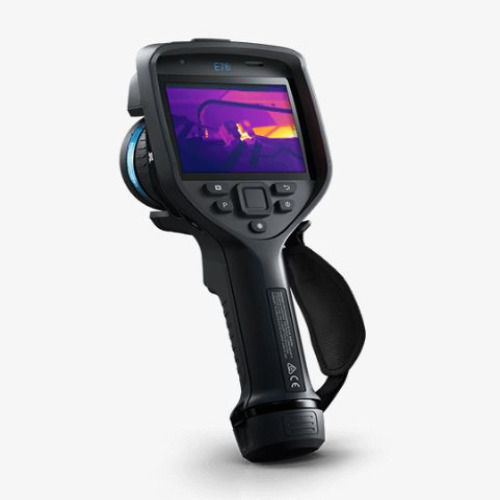
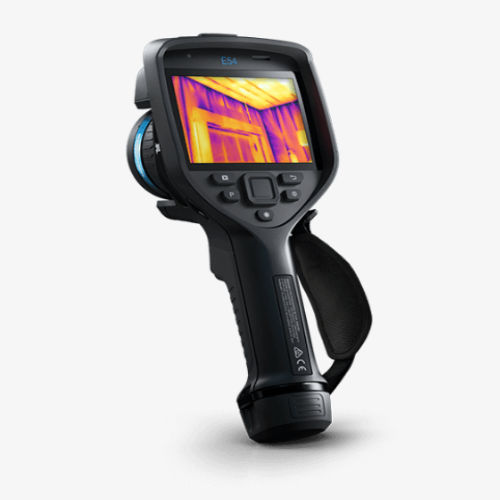
The FLIR E76 offers complete coverage of near and distant targets through a range of lens options. A step up from the FLIR E54, the E76 includes laser-assisted autofocus and 3 area measurement boxes. The 320 - 240 thermal resolution produces crisp, vibrant imagery that can be enhanced with patented FLIR MSX technology for added detail and perspective. The onboard FLIR Inspection Route runs pre-planned routes to help you stay organized when surveying large or multiple locations. FLIR Ignite provides automatic uploading of E76 images directly from the camera to the cloud for easy, secure storage and sharing
Exceptional Thermal Imaging PerformanceThe FLIR E76 delivers crisp, high-resolution thermal images with up to 320 240 IR pixels and an advanced uncooled microbolometer sensor. Its outstanding thermal sensitivity (<0.03C at 30C) allows users to detect minute temperature differences, making it ideal for predictive maintenance, electrical inspections, and building diagnostics.
User-Friendly Features and Rugged DesignWith a robust 2-meter drop test rating and industrial-grade housing, the E76 is built for tough environments. The 3.5-inch color touchscreen, on-board report generation, and intuitive controls paired with laser-assisted autofocus make field work efficient and simple, even in challenging conditions.
Flexible Connectivity and Data ManagementIntegrated WiFi, Bluetooth, NFC, USB 2.0, and FLIR Ignite cloud connectivity enable seamless data sharing, analysis, and device management. The device offers built-in memory, optional SD card storage, and supports on-board image analysis, ensuring secure and convenient data handling in any field scenario.
FAQ's of FLIR E76 Thermal Imager:
Q: How does the FLIR E76 measure temperature and what is its operating range?
A: The FLIR E76 utilizes a precision thermal sensor (uncooled microbolometer) to measure surface temperatures from -20C to 550C (-4F to 1022F). This range covers most industrial and building applications, enabling accurate detection of hot spots, insulation gaps, and equipment malfunctions.
Q: What image modes are available on the FLIR E76 and how do they benefit inspections?
A: The E76 offers several image modes: Thermal, Visual, MSX (Multi-Spectral Dynamic Imaging), Picture-in-Picture, and Gallery. These modes enhance clarity, overlay thermal detail onto visual images, and help users quickly pinpoint issues for efficient inspections and reporting.
Q: When should I use the interchangeable AutoCal lenses on the E76?
A: Interchangeable AutoCal lenses should be used when varying your application-such as wide-area surveys, general inspections, or focusing on distant or small targets. Lenses are available in 14, 24, and 42 to suit different fields of view and inspection requirements.
Q: Where can I store thermal images and reports from the FLIR E76?
A: Images and reports can be saved directly to the imager's built-in memory or transferred to an optional SD card. For remote access and backup, you can upload data via FLIR Ignite cloud connectivity, USB, WiFi, Bluetooth, or NFC.
Q: What is the process for focusing and capturing images with the E76?
A: You can focus manually or use the laser-assisted autofocus feature for fast, accurate focusing. Once focused, images are captured via the touchscreen interface or physical buttons, supporting both thermal and visual (standard or MSX) modes for detailed documentation.
Q: How does the FLIR E76 enhance safety and efficiency during use?
A: By offering real-time, non-contact temperature measurement and high sensitivity, the E76 quickly identifies anomalies without direct contact, reducing risks. Its rugged build, 2-hour field-swappable battery, and intuitive controls improve efficiency for long inspections.
Q: What are the main benefits of using the FLIR E76 for industrial inspections?
A: The E76 delivers precise thermal analysis, robust wireless connectivity, on-board reporting, and compatibility with various lenses, making it a trusted tool for predictive maintenance, energy audits, and troubleshooting in demanding industrial environments.





 Send Inquiry


 Send Inquiry